
David Baker
Transit
Norton (January, 2026)
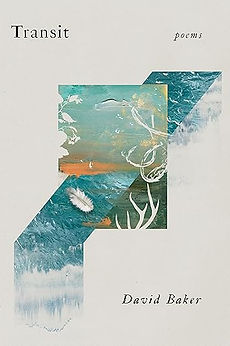

reviewed on May 27, 2026
Whereas his three previous collections thematize their titles at some length—Swift naming the darting and swooping of thought, Scavenger Loop the recursive procedures of his own post-Romantic poetics—David Baker’s new book, Transit, takes a more understated approach, eschewing an explanatory title poem and offering in place of a central organizing metaphor a series of “transits” geographical, temporal, and linguistic.
Many of the poems in Transit are walking-poems in the Romantic tradition, the most explicit resonance of the term that Baker takes up. “Roger Gilbert has a wonderful book, Walks in the World,” Baker writes in “Six Meditations on a Poem,” “about poetry, about poets walking, and the physical and meditative effect of just going on a walk.”
Wallace Steven’s poem "An Ordinary Evening in New Haven," Wordsworth’s masterpiece The Prelude, and so many more lyric poems take the occasion of the walk as a time to think and sing. Gilbert offers a typological sorting even the Puritans might appreciate. He says there are three distinct transformational effects that modern poets attain through the habit of walking: the cognitive, the meditation, and the aesthetic.
This kind of perambulation figures prominently in Transit, as Baker wanders through woods and fields and “under pawpaws between / the fence and little / creek” in poems which, though set in Ohio, draw heavily on the European lyric tradition. In this way, Baker resembles fellow Ohioan James Wright, whose Deep Imagism—including a number of walking-poems—drew likewise on poets like Trakl and Heine.
It matters, in fact, that these poems are set in Ohio.
As anyone who has driven I-71 well knows—through suburban monstrosities like Mason and Brecksville—the state brings rural landscapes into stark contrast with what Baker calls the “[r]eek and // runoff from the new development, there, / beyond the woods.” Ohio occasions in Transit not only ecopoetic critique of environmental degradation but Baker’s own self-critique of the impulse to riff on and romanticize the natural world. “What a thing looks like should give you its name,” he writes in the poem “Jewelweed.” “Where a thing grows, its other will be nigh— // Come on, that’s too much, who says nigh.”
I want to read a poem like “Watchers,” therefore, less as existential nocturne than as Boomer indictment, though readers will decide for themselves. Here is the poem in its entirety:
The barely tufted one. The gray small silent one.
The yellow-stripe-above-the-red-wing-striped one
in her black cardigan, though the day's still hot—
the little that’s left of day and the hazy high sky.
The one alone, two to the side. Shoulders aligned.
Then in minutes the dozen more pulling up
so quiet in golf carts we hear a soft munching
of gravel and one or two gulls flapping then
lifting from lamps flickering along the lake walk.
They’re tightly nosed-in in a row, like drive-ins
they remember, and the sun drifts lower still
beyond the boathouse in a long dazzle of
lake shimmering yellow softer toward gold.
They’re facing it all, beneath tall lindens,
like a breakwater for the village behind them.
It’s not far away. They are ready to go.
The bait-and-switch opening is a dis-orienting delight, but, if there is more than memento mori in “Watchers,” the would-be generational critique is almost impossibly implicit. I cannot be alone, though, in reading golf-carting leaf-peepers as the embodiment of Boomer privilege, and I suspect that Baker mobilizes nostalgia here in nigh parodic fashion.
Transit is indeed a nostalgic collection, tactically so. In place-based time-dissolves, Baker evokes a transit by which he returns to the places of his past, making Transit a quieter, more ruminative book in line with earlier titles like Sweet Home, Saturday Night (1991) and The Truth about Small Towns (1998). “I walked down to the water,” he writes in “Twilight Sleep.” “Dad picked me up—sixty years by. / Carried me over the river over stones over moon-glister there—.” The colloquial “sixty years by” is lovely, and the nostalgia here and throughout Transit feels like a summative taking-stock, a recognizable late-career crepuscularism, though Baker is still relatively young.
Far older are the etymologies to which Baker alludes across this book, a linguistic transit which undergirds present-day ecopoetic and ecopolitical critique. “Oikos,” he writes in a poem by that name. “Just look at the etymology there— / It’s the root from which ecology stems, but also— / Economy, a getting-and-spending of our earth.” Though the stage management is somewhat belabored, Baker returns to Hesiod in order to emphasize that, like Rome’s agricultural aristocracy, our own pastoral ease, such as it may be, is inevitably predicated on violence. The aptly named “The Colonists” develops that idea, describing “the road / cut by hand into rough cobbles […] [p]eople roped and lined up behind.” “Let’s take a walk, / you say,” Baker concludes, “by the frangipani again. What would you like / with your tea.”
That moment, bringing together both geographical and temporal transit, suggests the scope and stakes of the collection as a whole. Transit is a meditative, almost brooding, reflection on the passage of time and passage through space, a quieter book, perhaps, than predecessors like Whale Fall, but no less moving in its movements.