
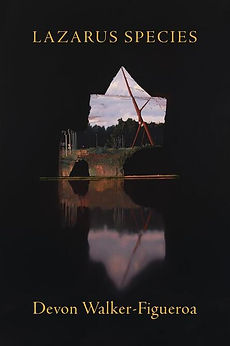

reviewed on April 8, 2026
In an era and culture in which language is routinely reduced—in the way that clarified butter is reduced—to utilitarian “information” and political and pop-cultural non-speak, techniques like difficulty, opacity, obliquity, and allusion constitute one of the more sweeping and paradigm-shifting interventions a writer might undertake; it hardly requires a Ph.D. on Wittgenstein to appreciate that the language in which we conceive our social and political lives determines their contours and complexion.
Immaculate of overtly “political” subject matter, Lazarus Species intervenes formally, rather, in a culture industry committed to the transformation of the fetishized self into consumer commodity, from the Kardashians to Khaby Lame, from Facebook to the Ruth Lilly Fellowship. In the follow-up to her 2021 debut Philomath—the first-ever poetry finalist for the NBCC’s John Leonard Prize—Walker-Figueroa develops a wilder, more dissociative and sometimes surrealist poetics, moving away from the stabilizing situation and autobiographical first-person. Where her perennially traumatized contemporaries might have made a great deal of hay, Walker-Figueroa relegates the self to footnotes and sub-footnotes, to the point that only in note 25, sub-note c., in a late epistolary poem to T. E. Lawrence, do we learn that “[a]t the age of six, I lost my virginity to a family friend.” Only at the end of an apparently non sequitur sonnet crown in the voice of boxer Jack Dempsey, in footnote 25, sub-note i., are we given the ostensible autobiographical occasion for the sequence: “Jack Dempsey Ross was the name of my mother’s father. […] I, too, left home and high school at age fifteen, though I’ve never learned how to throw a punch.”
Like a boxer, in fact, the self of Lazarus Species feints and retreats again and again, concealed in persona, puns, epistolary, etymology, ekphrasis, and above all in the brocaded surfaces and rococo acoustics that dominate the book. That poetics is thematized in the masterful early poem “The Perch,” in which subject and object blur and overlap in ekphrastic involution:
[…] our perch keeps on
emulating sleep, along
with several other leathern lives
shelved behind this their filthy
length of glass. (Glass, I am
told, lacks “long-
range order,” moving invisibly down-
ward, a solid matter longing
to be water.) A little stiff,
I have to shift my weight now,
also my eyes
from the bony perciform network of his skull—
its shifty structure free of the bizarre
articulations zippering my skull’s plates—
down to his hindmost fins.
Texturally layered, Walker-Figueroa’s poetics is also textually layered, as “The Perch” invokes not only Bishop’s legendary “The Fish” but more subtly Frost’s architectural ekphrasis “Directive.” “Inside him,” Walker-Figueroa writes, “(if you can make your- / self small) you’ll find a hall / so huge, dead gods / must come alive....” Here is Frost: “And if you’re lost enough to find yourself / By now, pull in your ladder road behind you / And put a sign up CLOSED to all but me. / Then make yourself at home. The only field / Now left's no bigger than a harness gall.”
Admirably evasive in its autobiography, Lazarus Species nonetheless indulges on occasion an almost slam-like silliness, the price, perhaps, of the dissolution of self in sound. “I can’t / know, so I incant / to no one,” Walker-Figueroa writes, “am slated // to translate what can’t be mutated / nor muted out // of mystery, be / mutilated nor made // unearthly whole.” Combined with the panoply of traditional forms in the book—villanelles, sestinas, sonnets, ghazals—Lazarus Species sometimes feels like a catalog of exercises, their technical proficiency occluding more sustained thinking-on-the-page, an effect of which Walker-Figueroa seems archly aware. “Truth is,” she writes, “I’ve always loved those voices / that couldn’t get over themselves, the ones that floated / into the ferment of shady bars, only to get into fights / with themselves they had no hope of surviving.” As Walker-Figueroa puts it, her poetics is “[s]o wild we call it | stiff.” “It’s overkill,” she writes in another poem, winkingly.
She is, in other words, alert to the risks she is running.
To privilege as Walker-Figueroa does the signifier over the signified, word over referent, is to efface not only that subject, that “self,” trafficked so titillatingly across the culture, but also those broader economies, ideologies, and institutions that underly our contemporary corporate order. For Walker-Figueroa, the impulse toward clarity is an imperialistic one, part of a western gambit to rationalize or systematize an otherwise dispassionate world. Nikola Tesla’s “future / ‘All-seeing eye,'" for instance—a proposed global surveillance and communication system— will “scan the Earth […] until // All opacities yield to optics.” Mao Zedong’s gargantuan Three Gorges Dam will lead to “whole weather systems // Tamed between two walls, / And night detained, so it might learn // How long the day might finally grow.” It is a masterful, mic-drop ending to the gorgeously dense late poem “My Invention,” and it is fearsome in its indictment of that knowledge known as “Enlightenment.”
Lazarus Species is structured throughout around similarly rich long-poems, thick in their layering, mobile in their swerves and recursions. Shifting vertiginously between clarity and opacity, Walker-Figueroa resembles Ashbery in her playfulness, Angie Estes in her wit and range of reference. These are unabashedly “intellectual” poems at a moment when sustained thinking of any kind has become a counter-cultural act. One might even learn a new word in Lazarus Species—my God.